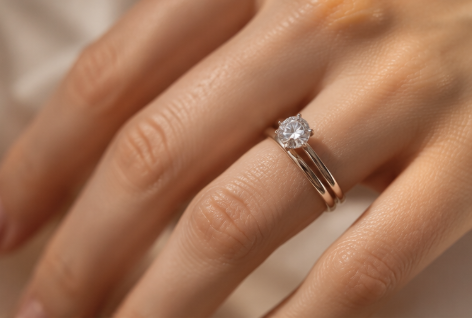
Which finger do you wear an engagement ring and wedding ring on: a clear guide for couples
Which finger do you wear an engagement ring and wedding ring on? The answer is not only about tradition, but also about personal comfort. Customs may differ from country to country and from family to family, so the most important thing is to understand the meaning of each ring and choose a way of wearing them that feels natural for your couple.
An engagement ring is usually connected with the proposal, while a wedding ring is connected with the marriage ceremony. They can be worn on the same hand, on different hands, together on one finger, combined into one set, or moved after the wedding. There is no single mandatory scenario, but there are familiar options that make the choice easier.
Which finger are engagement and wedding rings usually worn on
Most often, both an engagement ring and a wedding ring are worn on the ring finger. This comes from long-standing symbolism: the ring finger is associated with love, union, and a family promise.
The main difference is the hand. In some traditions, rings are worn on the right hand; in others, on the left. For example, many couples in Poland are more used to wearing a wedding ring on the left hand, while in some Eastern European traditions the right hand is more common. At the same time, modern couples increasingly consider not only custom, but also comfort, lifestyle, and the design of the jewellery.
Before the wedding, the engagement ring is usually worn on the ring finger of the hand that is customary for the couple’s family or country. After the wedding, it can stay next to the wedding ring, be moved to the other hand, be worn only on special occasions, or be combined with the wedding ring in one carefully designed set.
Engagement ring: which hand and finger to wear it on
An engagement ring is traditionally worn on the ring finger. It appears before the wedding and symbolises the couple’s intention to build a family. Most often, it is a ring with a central stone: a diamond, a coloured gemstone, or a more minimalist setting, depending on the bride’s taste.

Before the wedding, the engagement ring may be the main piece of jewellery on the hand. That is why it should not only look beautiful, but also feel comfortable every day: it should not catch on clothes, interfere with daily life, sit well on the finger, and have an appropriate setting height for the stone.
What to do with the engagement ring on the wedding day
On the wedding day, many brides temporarily move the engagement ring to the other hand so that the wedding ring can take its place first. After the ceremony, the engagement ring can be returned to the same finger and worn above the wedding ring.
This order has symbolic meaning: the wedding ring sits closer to the hand, while the engagement ring complements it as a reminder of the proposal. But it is not a rule - it is simply one beautiful option.
You can choose any scenario:
- wear the engagement ring and wedding ring together on the same ring finger;
- move the engagement ring to the other hand;
- keep the engagement ring for outings and special occasions;
- order a wedding ring designed to pair harmoniously with the engagement ring;
- choose a transformer ring, where the engagement ring becomes part of the wedding set.
Wedding ring: which finger to wear it on after the wedding
A wedding ring is almost always worn on the ring finger. Since it is designed for everyday wear, its shape, width, profile, and exact size are especially important. Even a small difference in fit can be noticeable when a ring stays on the hand every day.

At KiANIT, wedding rings are selected not only by appearance, but also by how they feel on the hand. It is important for a couple to try different widths and profiles: the same ring can look delicate on one hand and too substantial on another. That is why trying rings with ring sizers helps you understand in advance which option will be comfortable in real life.
Right or left hand: how to choose
When choosing rings for yourselves, focus on three factors: tradition, comfort, and aesthetics. Tradition answers the question “what is customary,” comfort answers “what feels good,” and aesthetics answers “how the rings look together.”
Some couples decide in advance that both partners will wear their wedding rings on the same hand. Others choose individually: for example, if someone is left-handed, works with their hands, or wears a watch and jewellery in a particular way. This is completely normal: a wedding ring should become part of life, not something you constantly want to remove.
How to wear an engagement ring and wedding ring together
If the engagement ring and wedding ring are meant to be worn together, it is better to think about this before the wedding ring is made. The height of the stone, the shape of the bands, the way the rings sit next to each other, and the overall balance all matter. Sometimes a straight classic wedding ring sits beautifully next to an engagement ring. In other cases, a thinner model, a ring with a soft curve, or a set where two pieces join into one form may look better.
It is especially important to check whether the rings rub against each other. If the jewellery constantly touches with protruding details, signs of wear may appear on the metal over time. That is why the combination should not be judged only visually: it is worth trying the set on the hand, moving the fingers, and checking whether the rings feel comfortable next to each other.
Transformer rings: when the engagement ring becomes part of the wedding ring
A separate modern option is a transformer ring. This is a set in which the engagement ring with a central stone is inserted into a specially designed wedding ring form. As a result, the two pieces join into one composition: the engagement ring sits inside the wedding ring, while the wedding ring becomes like a frame or case for it.

This design suits couples who want to wear both symbols together, but not as two separately chosen rings - rather as one complete set. The engagement ring keeps its role as a reminder of the proposal, while the wedding ring adds the meaning of marriage and completes the composition. Visually, it looks like one piece of jewellery: the central stone remains the main accent, and the lines of the wedding ring frame it and make the design more expressive.

A transformer ring is convenient because the way it will be worn is considered from the beginning. After the wedding, there is no need to look separately for a wedding ring that matches the engagement ring in height, shape, and spacing between the bands. In such a set, it is already planned how the rings will connect, where the stone will sit, and how comfortable the jewellery will feel on the finger.
There is also a practical point. If two standard rings do not match in shape, they may touch, shift, or visually compete with each other. In a transformer ring, the engagement part and the wedding part are created as a pair, so they look more harmonious and sit more predictably.

When choosing such a set, it is important to try it in two versions: separately as an engagement ring and together with the wedding part. This helps you understand whether it is comfortable for daily wear, whether the central stone gets in the way, whether the parts connect easily, and whether you like the feeling of a more dimensional design on the hand.
Transformer rings are especially suitable for those who want to keep wearing the engagement ring every day after the wedding. Instead of moving it to the other hand or saving it for special occasions, it can become part of the main wedding set.
At KiANIT, this format is best discussed at the individual order stage. A transformer ring requires precise proportions: the shape of the central stone, the width of the wedding part, the setting height, the metal, the fineness, and the fit on the finger. This way, the set will be not only impressive, but also comfortable in real life.
Which order of rings to choose
Most often, after the wedding, the wedding ring is put on first and the engagement ring second. This means the wedding ring sits closer to the palm. For many couples, this is a beautiful symbol: first the marriage, then the memory of the proposal.
But there are other options. The engagement ring can be worn on the left hand and the wedding ring on the right, or vice versa. They can also be changed depending on the look. If the engagement ring is larger, with a high central stone, it may sometimes be more comfortable to wear it separately to keep everyday wear feeling lighter.

If a transformer set is chosen, the order becomes simpler: the engagement ring is inserted into the wedding part and worn as one composition. In this case, the couple decides in advance not only which finger the rings will be worn on, but also how they will connect after the wedding.
When family traditions are different
International couples often ask: which finger do you wear an engagement ring and wedding ring on if the families have different customs? For example, one side may be used to the right hand, while the other is used to the left. In this situation, there is no need to look for one single correct answer.
The best solution is to agree on the meaning. You can choose the hand that is customary in the country where the ceremony takes place. You can follow the family tradition of one partner. Or you can create your own rule: for example, wear the wedding rings the same way, while the engagement ring is worn in the way that is most comfortable for the bride.
Rings remain a symbol of the couple, not an exam in tradition. Their purpose is to remind you every day of the decision to be together.
What to consider when choosing a wedding ring
When a couple thinks about the finger and the hand, it is easy to forget the most important thing: the fit. A wedding ring should pass comfortably over the knuckle but not be too loose at the base of the finger. Fingers can change slightly throughout the day due to temperature, activity, travel, or season. That is why the size should not be chosen in a rush or based on one random measurement.
At KiANIT, when selecting wedding rings, we consider the metal, fineness, width, profile, and preferred fit. For gold rings, 585 and 750 fineness options are available, as well as platinum for those looking for an especially restrained and durable metal. The choice depends on the design, lifestyle, and the feeling on the hand.

Engraving can also affect how the ring feels emotionally. It does not change the tradition of wearing the ring, but it makes the jewellery more personal: inside, you can place a date, initials, or a phrase that only the two of you understand.
How to choose rings that look harmonious together
The engagement ring is usually chosen earlier, while the wedding ring is selected closer to the wedding. That is why the wedding ring often has to be matched to an existing piece of jewellery. Here, not only the same hand matters, but also visual compatibility.
Pay attention to several details:
- metal colour: white, yellow, red, or rose gold, platinum;
- the width of the wedding ring next to the engagement ring;
- the profile shape: flat, rounded, softer, or more expressive;
- the height of the stone setting in the engagement ring;
- comfort if two rings are worn next to each other or joined into a transformer set;
- the possibility of wearing the engagement ring separately before the wedding and together with the wedding part after the ceremony.
Sometimes the ideal combination is not an exact match, but a calm dialogue. For example, a minimalist wedding ring can emphasise the diamond in an engagement ring, while a ring with delicate stones can support the sparkle of the central stone.
With transformer rings, harmony is created differently: not by selecting two similar pieces, but through one unified construction. The engagement ring becomes the central part, while the wedding ring complements it in both form and meaning.
Can you wear rings outside the rules
Yes, you can. Modern etiquette has become more flexible: no one is required to wear an engagement ring and wedding ring according to one strict scenario. What matters is that the jewellery suits your rhythm of life and keeps its meaning.
Some people wear the wedding ring constantly and put on the engagement ring for dinner, meetings, or family celebrations. Some wear both rings together every day. Some move the engagement ring to the other hand after the wedding so that the wedding ring remains the main symbol. And some choose a transformer ring so that the engagement and wedding jewellery become one set.
Such decisions do not make the jewellery less meaningful. On the contrary, they show that the couple chooses not only tradition, but also their own comfort.
How KiANIT helps you choose the right option
At the KiANIT Jewelry showroom in Browary Warszawskie at Grzybowska 43A in Warsaw, you can try different options and see how the rings look on the hand. This is especially important if you are choosing between the right and left hand, different widths, or want to wear the engagement ring and wedding ring together.

The KiANIT team helps select the shape, metal, fineness, and fit so that the ring is not only beautiful during the fitting, but also comfortable every day. If you like the idea of a transformer ring, it is better to discuss it in advance: such a set requires especially precise work with proportions and fit, so that the engagement part connects easily with the wedding part and looks complete.
Precision is essential for wedding rings: the jewellery goes from the idea and parameter selection to careful production and final checking. This approach helps avoid a random choice and create rings that truly belong to your story.
Which finger to wear an engagement ring and wedding ring on
In short, both rings are most often worn on the ring finger. The engagement ring is worn before the wedding as a symbol of the proposal, and the wedding ring after the ceremony as a sign of marriage. The hand can be right or left: it depends on tradition, country, family, and personal comfort.
Which finger to wear an engagement ring and wedding ring on is an important question, but it is not more important than the feeling that the jewellery suits you. If the rings combine beautifully, sit comfortably, and reflect your couple, then the option you chose is the right one.
An engagement ring and wedding ring can be worn next to each other, on different hands, or as one transformer set, where the engagement ring is inserted into the wedding ring. This format is ideal for those who want to keep both symbols in one piece of jewellery and wear them together every day.
At KiANIT, you can try different forms, choose the size with ring sizers, discuss how the engagement ring and wedding ring can work together, and consider the transformer ring format. Book a consultation at the showroom in Warsaw - we will help you find a calm, beautiful, and comfortable solution for your couple.