GIA, HRD, IGI Diamond Certificates: Why They Matter and How to Read Them
GIA, HRD and IGI diamond certificates help you understand exactly which stone you are choosing: its weight, colour, clarity, cut quality, origin and additional characteristics. For someone choosing an engagement ring for the first time, this document is not a formality, but a calm point of reference for making a confident decision.
A certificate does not make a diamond beautiful by itself. It records the stone’s parameters and allows you to compare options not “by eye”, but by clear criteria. At KiANIT, we help read diamond certificates in simple language: we explain which lines truly affect the appearance of the stone and which are mainly important for identification and confirmation of characteristics.
What is a diamond certificate?
A diamond certificate is a gemmological report issued by an independent laboratory. It describes the key characteristics of the stone: carat weight, colour, clarity, cut, measurements, polish, symmetry, fluorescence and other details.
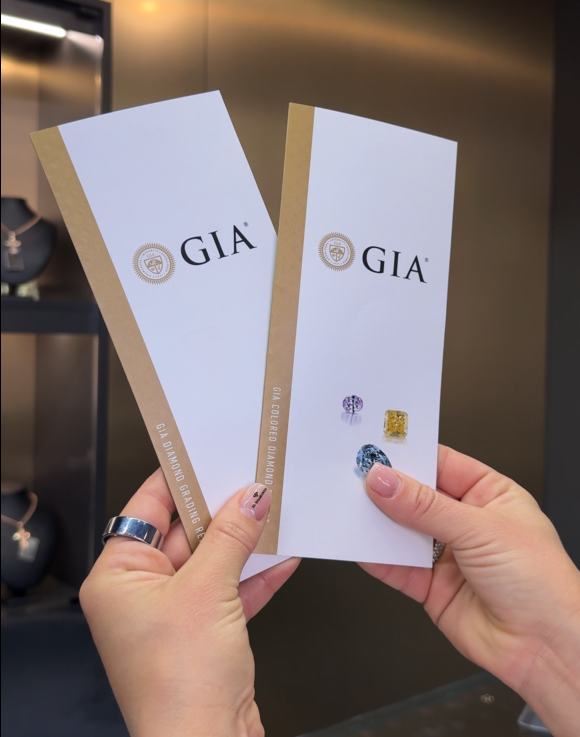
Most often, a diamond is assessed using the 4C system: Carat, Color, Clarity and Cut. GIA describes 4C as a universal standard for evaluating diamond quality, and IGI and HRD also use these parameters in their reports.
It is important to understand that a certificate is not a marketing description and not a promise of a “perfect” stone. It is a technical document that helps you see the diamond’s strengths and possible nuances before purchase.
Why a certificate matters when choosing an engagement ring
The main purpose of a certificate is transparency. When a diamond has a GIA, HRD or IGI report, the buyer sees not only the stone’s size but also its actual characteristics. This is especially important for an engagement ring, where the decision should feel thoughtful and reassuring.
A certificate helps to:
- confirm that the stone matches the declared parameters;
- compare several diamonds with each other;
- understand the balance between size, colour, clarity and cut;
- check the report number in the laboratory database;
- record the stone’s characteristics for personal peace of mind.
For example, two diamonds of the same carat weight can look different. One may appear brighter thanks to a well-executed cut, another may look visually larger because of its proportions, and a third may be more balanced in budget because of a slightly warmer colour or a different clarity grade. A certificate helps you see these differences before the ring is made.
GIA, HRD, IGI: what is the difference between the laboratories
GIA, HRD and IGI are well-known international gemmological laboratories that issue reports on diamond characteristics. In everyday engagement ring selection, what matters is not only the name of the laboratory, but also that the certificate is authentic, the data matches the stone, and the parameters are properly explained to the buyer.
GIA
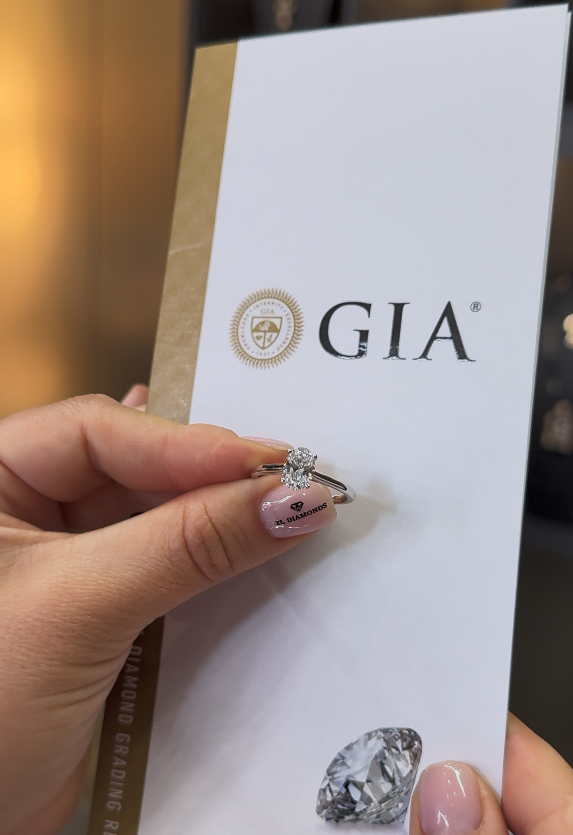
GIA is often regarded as one of the strictest and most recognisable standards in diamond grading. On the GIA website, you can check a report number through Report Check and compare the certificate data with the information in the laboratory’s database.
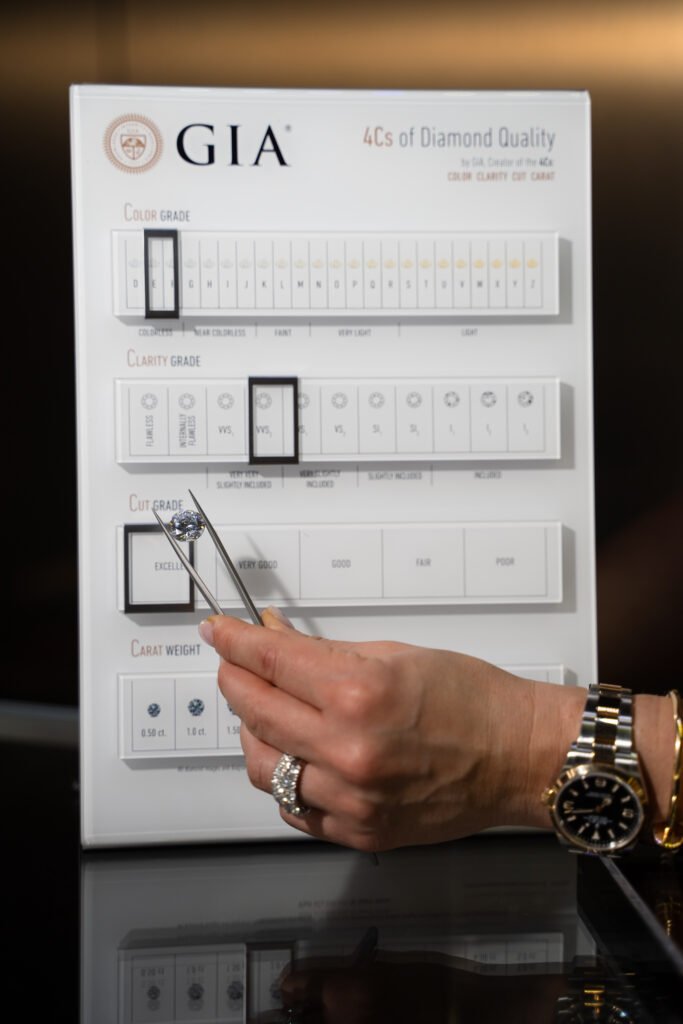
GIA reports include 4C, measurements, shape, cut grade for round diamonds, polish, symmetry, fluorescence and other data. For the buyer, this is a convenient way to receive an independent picture of the stone.
HRD
HRD Antwerp is connected with the Belgian gemmological tradition and Antwerp, one of the important centres of the diamond industry. In its materials, HRD emphasises that a diamond report covers 4C and helps the buyer understand exactly what kind of stone they are purchasing.
HRD certificates are often found on the European market. When choosing a diamond, it is equally important to read the parameters carefully: not only weight, but also colour, clarity, cut, polish, symmetry and fluorescence.
IGI
IGI is known for actively certifying both natural and laboratory-grown diamonds. IGI reports indicate the stone’s origin, shape, cutting style, measurements and 4C grading.
For the buyer, this is especially useful when comparing natural and laboratory-grown diamonds. The origin of the stone should be clearly stated in the certificate so that the choice is conscious and transparent.
How to read a diamond certificate: the key lines
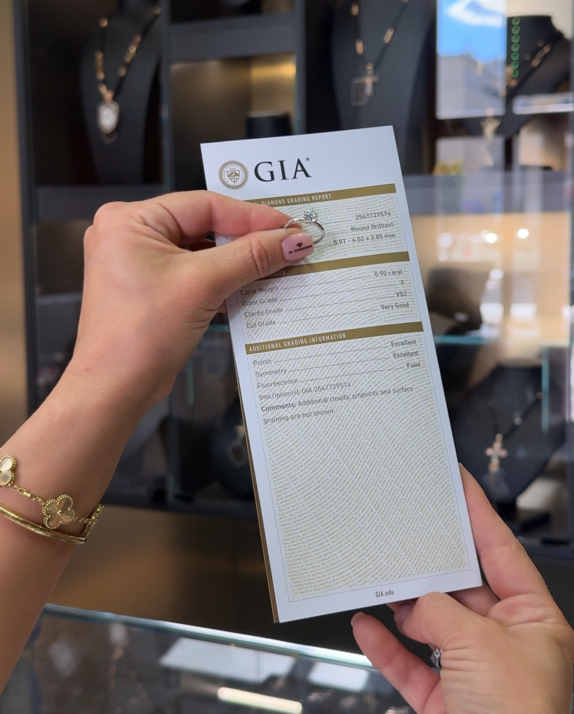
A certificate may look technical, but it becomes easier to read when you go through it step by step. You do not need to memorise every term at once. It is enough to understand which parameters affect appearance, which are used for identification, and which help compare stones with each other.
Report number- certificate number
The report number is the individual number of the document. It can be used to verify the certificate on the laboratory’s website. GIA has a Report Check service where report data can be compared with the information in the GIA database.
If a diamond has a laser inscription of the number on the girdle, this is an additional way to connect the stone with the certificate. The girdle is the thin outer edge around the diamond. The inscription is usually very small and visible only under magnification.
Shape and cutting style- shape and type of cut
Shape is the outer silhouette of the stone: round, oval, pear, emerald, princess, cushion and other options. Cutting style describes how the facets are arranged.
Beginners often think that “cut” and “shape” are the same thing, but they are different. Shape defines the silhouette, while cut quality defines how the stone interacts with light. Cut has a major influence on brilliance, sparkle and the liveliness of a diamond.
Measurements- dimensions
Measurements show the diameter or the length, width and height of the stone in millimetres. This matters because carat weight does not always look the same on the hand.
For example, two diamonds may have the same mass, but one can appear visually larger due to its shape and proportions. That is why, when choosing an engagement ring, we look not only at carat weight but also at the real measurements of the stone.
Carat weight- weight in carats
A carat is the unit of mass used for diamonds. One carat equals 200 milligrams; this is the standard definition used by gemmological laboratories.
Weight affects how the stone is perceived, but it is not the only measure of beauty. Sometimes a slightly smaller diamond with a better cut looks brighter and more expressive than a larger stone with less successful proportions.
Color grade- colour
Colour grade shows how close a diamond is to being colourless. In the classic GIA scale, grading begins with D- the colourless range- and as the alphabet moves forward, the tint becomes more noticeable.
For a beginner, it is important not to chase the highest letter automatically. In jewellery, colour is perceived together with the metal, the shape of the stone, the setting and the lighting. For example, in yellow gold, a slight warmth in a diamond may look natural and harmonious, while in white metal the tint is usually more visible.
Clarity grade- clarity
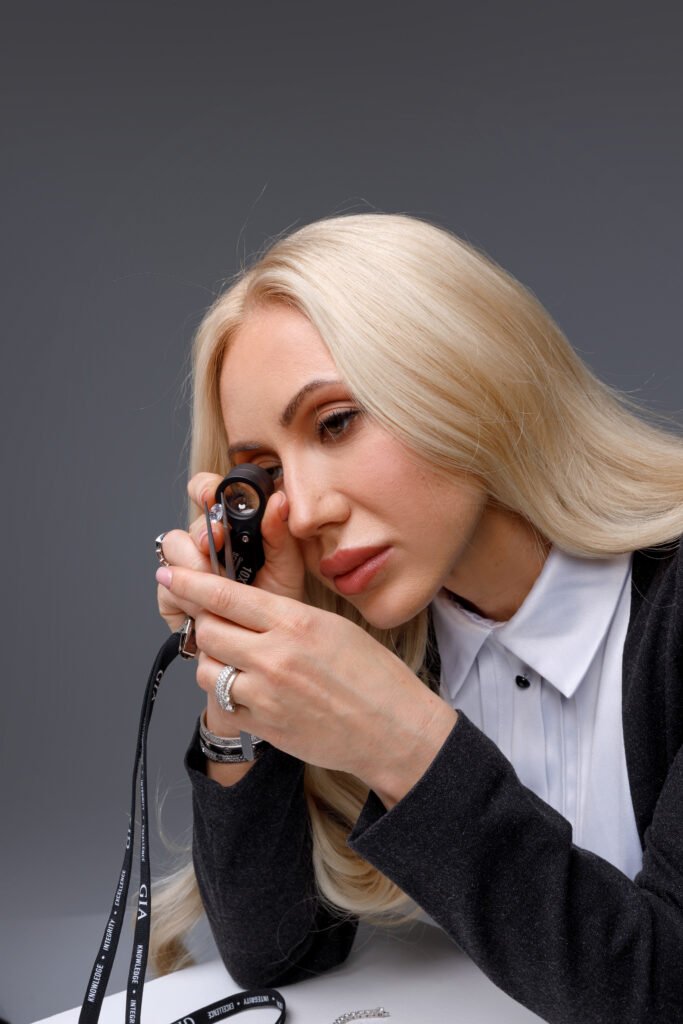
Clarity describes the internal and external characteristics of a diamond: inclusions, points, clouds, growth lines and surface features. GIA uses an 11-grade clarity scale, and the assessment considers features visible under 10x magnification.
The main question for the buyer is not only which grade appears in the certificate, but whether the features are visible to the naked eye. Many inclusions are noticeable only to a gemmologist under magnification and do not interfere with the beauty of the ring in everyday life.
Cut grade- cut quality
Cut grade shows how well the stone returns light. For round diamonds, certificates often include a cut grade, ranging from higher to lower depending on the laboratory’s grading system.
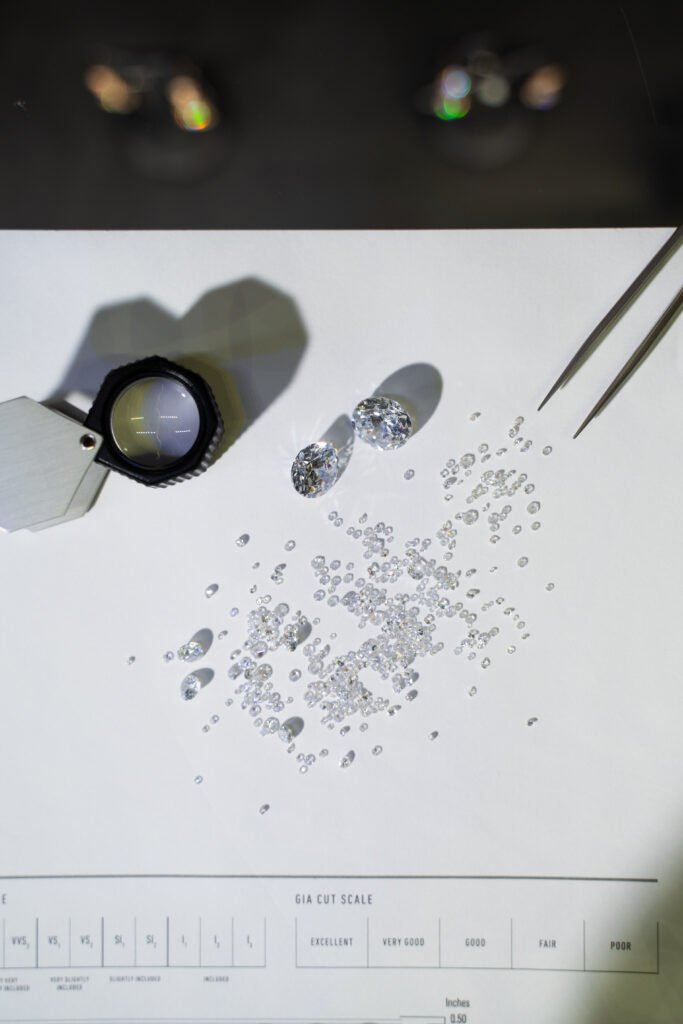
Cut is what can make a diamond look alive. Good colour and clarity cannot compensate for weak light performance if the stone appears dull. That is why, when choosing an engagement ring, we pay attention not only to “size” but also to how the diamond shines in motion.
Polish and symmetry- polish and symmetry
Polish shows the quality of the facet surfaces. Symmetry indicates how precisely the facets are positioned in relation to one another.
These parameters are not always easy to evaluate without experience, but they help understand the overall level of cutting execution. For the buyer, they are additional points of reference, especially when comparing several stones with similar weight, colour and clarity.
Fluorescence- fluorescence
Fluorescence is a diamond’s reaction to ultraviolet light. GIA emphasises that fluorescence is not part of 4C, but an identifying characteristic; in reports, it is described by intensity, for example None, Faint, Medium, Strong or Very Strong.
There is no need to automatically be afraid of fluorescence. In some cases it has almost no effect on appearance, while in others it may be noticeable. It is best to assess it together with the specific stone, its colour, transparency and the purpose of the jewellery.
Comments- comments
In the comments section, the laboratory may include additional information: features of the stone, the presence of a laser inscription, or clarifications of characteristics. This section is often skipped, but it is worth reading carefully.
If the comments contain an unclear phrase, it is better not to interpret it on your own. A gemmologist or consultant can explain whether it matters for appearance, durability or the choice of setting.
Natural or laboratory-grown diamond: where it is stated
In a modern certificate, it is important to look at the stone’s origin. A natural diamond was formed in nature, while a laboratory-grown diamond was created in controlled conditions, although it can have similar physical and optical properties.
IGI separately notes that its diamond reports indicate natural or laboratory-grown origin and record 4C parameters. That is why, when choosing, it is important to read not only the large lines with weight and colour, but also the description of the stone type.
For KiANIT, it is essential that the client understands exactly what they are choosing. We calmly explain the difference between natural and laboratory-grown diamonds, show the documents and help select a stone that matches the meaning of the jewellery.
How to compare two diamonds by certificates
The most common mistake is comparing diamonds only by weight. In practice, a beautiful choice is built on balance. Sometimes a slightly smaller stone with a better cut and more successful proportions looks more expressive than a larger option.
A convenient order for comparison:
- Check the laboratory and certificate number.
- Compare the origin of the stones.
- Look at the shape and real measurements in millimetres.
- Evaluate the colour with the future ring metal in mind.
- Check clarity and ask whether inclusions are visible to the eye.
- Pay attention to cut, polish and symmetry.
- Read fluorescence and comments.
- View the stone in person or on a high-quality video.
A certificate gives facts, but the final choice is always connected with perception. A diamond should appeal not only in the lines of the report, but also in the real ring: on the hand, in movement, in soft daylight and evening light.
Can you buy a diamond without a certificate?
For an important engagement ring, a certified diamond is a calmer and more transparent choice. This is especially true when it comes to the centre stone, which defines the character of the entire piece.
Without a certificate, it is harder to verify the declared characteristics. The buyer effectively relies only on the seller’s words. At KiANIT, we believe that a conscious choice begins with clear information: what stone it is, what parameters it has, what document confirms them, and why this particular option suits the ring design.
Small accent diamonds in a piece of jewellery may not have a separate certificate for each stone. But for the central diamond in an engagement ring, a GIA, HRD or IGI report helps avoid unnecessary doubts.
What to ask before buying
Before approving a diamond for an engagement ring, it is worth asking a few questions. They will help you avoid getting lost in terminology and make the decision more confidently.
Ask the consultant:
- whether the certificate number can be checked;
- whether the diamond is natural or laboratory-grown;
- whether inclusions are visible without magnification;
- how the colour will look in the chosen metal;
- whether there is fluorescence and whether it affects the appearance;
- whether the stone’s proportions suit the chosen setting;
- how the diamond will be set in the ring.
A good consultant does not rush or complicate things. They translate the language of the certificate into normal human language: they show where the important lines are in the document, explain compromises and help choose not the “loudest” characteristic, but a harmonious stone.
How KiANIT helps choose a certified diamond
At KiANIT, we choose a diamond for the future story of the ring: the shape of the hand, the bride’s style, the metal, the stone setting and the desired visual impression. A GIA, HRD or IGI certificate helps us speak with the client precisely and transparently.
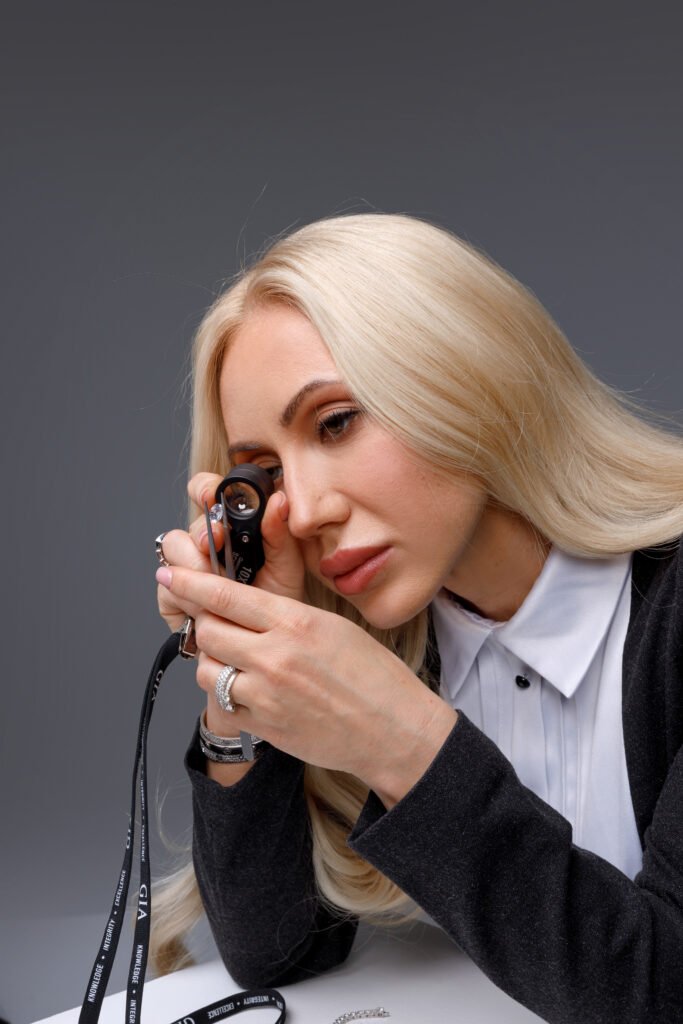
We explain 4C in simple words, show how to read the document, and draw attention to fluorescence, proportions and comments. If several diamonds look similar in the certificate, we help understand which one will look more beautiful in the actual piece of jewellery.
An engagement ring can be discussed at the KiANIT showroom in Browary Warszawskie at Grzybowska 43a in Warsaw. During the consultation, we will select the stone, explain the certificate and calculate the jewellery individually- taking into account the metal, design, diamond characteristics and the desired look.
Conclusion: a certificate is the language of trust
GIA, HRD and IGI diamond certificates are not meant to make the choice more complicated, but to make it calmer. They help you understand the weight, colour, clarity, cut, origin and features of the stone before it becomes part of an engagement ring.
The most important thing is not to read the certificate separately from the real impression. The document shows the facts, while the jewellery should create a feeling. When these two parts come together, the choice becomes truly confident.
At KiANIT, we will help you understand the certificate, compare diamonds and choose a stone that will look beautiful not only in the report, but also in the ring- every day, in your personal story.