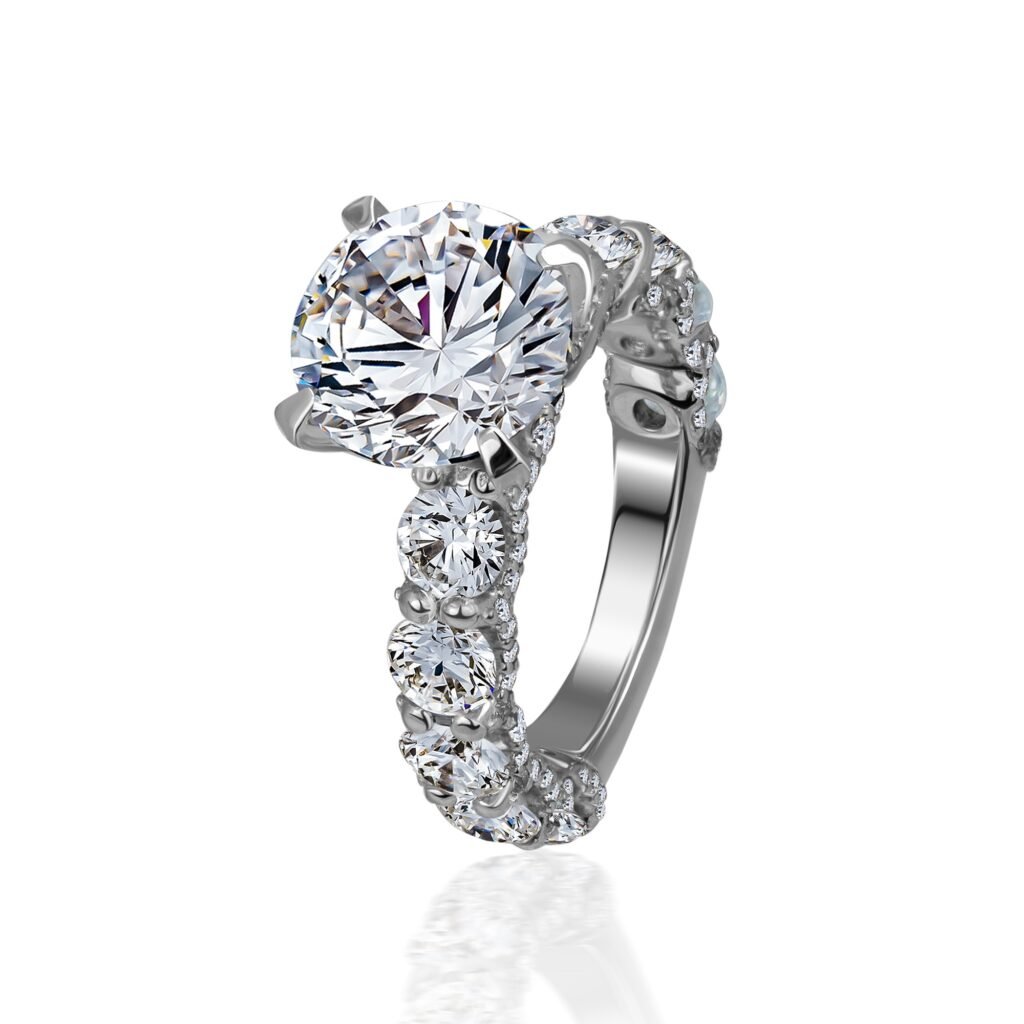
Diamond clarity: when you do not need to overpay
Diamond clarity: when you do not need to overpay is an important question when choosing an engagement ring. At first, it may seem that the higher the grade, the better the stone. In practice, what matters more for jewellery is not the highest line in the certificate, but how the diamond looks in real life: whether it sparkles, whether inclusions are visible without magnification, and whether it works harmoniously with the setting.
Clarity is one of the 4C characteristics, together with carat weight, colour and cut. It describes the internal features of the stone: tiny inclusions, points, clouds and natural growth marks. Most of them are visible only under magnification, so a buyer does not always need to aim for the highest category.
What diamond clarity means in simple words
Diamond clarity shows how free a stone is from internal inclusions and external features. In nature, a diamond forms under high pressure, so small natural marks are a normal part of its origin. After cutting, these features are assessed by a laboratory and listed in the certificate.

For a beginner, it is important to understand that clarity is not the same as beauty. Two diamonds with different clarity grades can look almost identical in a ring if the inclusions are not visible to the naked eye. And two stones with the same clarity grade can look different because of the position of inclusions, the cut and the shape.
That is why at KiANIT we look not only at the line in the certificate, but also at the live impression of the stone. For an engagement ring, the diamond should look beautiful in real wear, not only “perfect” on paper.
How to read the diamond clarity scale
In GIA, HRD or IGI certificates, clarity is marked with letters. The scale helps compare stones, but it is best treated as a guide, not as the only selection criterion.

FL and IF: almost absolute clarity
FL and IF are the highest categories. These diamonds have minimal features that are difficult to detect even during professional assessment. They are rare stones, chosen when not only visual beauty matters, but also the idea of an almost flawless characteristic.

For an engagement ring, this level of clarity is not always necessary. If inclusions in a lower-grade stone are not visible without magnification, the visual difference may be unnoticeable to the eye.
VVS: very high clarity
VVS means that the inclusions are extremely small and difficult to detect under magnification. It is a premium characteristic that gives peace of mind to those who want a stone with a very high clarity reserve.
But here an important question appears: will you notice the difference in the finished ring? In most cases, a person first sees the shape, sparkle, size, metal colour and overall design. That is why VVS should be considered consciously, not automatically.
VS: a smart balance for many rings
VS often becomes a strong balance between characteristics and visual result. Inclusions in such diamonds are usually small and often not visible without magnification. For many engagement rings, this is the level at which the stone looks clean, while the choice remains rational.

VS works especially well in cuts with active sparkle: for example, round, oval, cushion or pear. Brilliance and the movement of light help hide small natural features.
SI: worth considering, but carefully
SI is a category where inclusions can already be more noticeable. But this does not mean that all SI diamonds are poor choices. Some SI stones look visually clean if the inclusions are closer to the edge, disappear in the play of light or do not draw attention in the setting.
Here, live viewing and professional selection are especially important. With a large centre stone or an open setting, you need to be more attentive. For some designs and shapes, SI can be a good solution, but only after assessing the specific diamond.
When you do not need to overpay for diamond clarity
You do not need to overpay for diamond clarity if the difference is visible only in the certificate, but not to the eye. For a ring worn every day, the visual effect matters more: the stone should sparkle, look clean and sit beautifully in the setting.
There are several situations where you can choose more calmly:
- the stone looks clean without magnification;
- the inclusions are not located in the centre of the table;
- the cut gives active brilliance and works well with light;
- the setting partially hides the area with a natural feature;
- the difference between two categories does not change the appearance of the ring.
In such cases, higher clarity may be a pleasant characteristic, but not a necessary one. Sometimes it is wiser to focus on cut, shape or colour, because these have a stronger influence on the first impression of the jewellery.
When it is worth paying more for clarity
There are situations where higher clarity truly matters. First of all, this applies to larger diamonds: the bigger the stone, the easier it is to notice internal features. What is almost invisible in a smaller size may become more obvious in a centre stone.
Clarity is also more important for cuts with a calmer play of light. Emerald cut and other step-cut shapes do not sparkle with many small flashes, but with broad mirror-like reflections. They look very elegant, but they often reveal more of the stone’s inner world. That is why clarity should be chosen especially carefully for these shapes.

Paying more may be justified if:
- the diamond is large and open in the setting;
- you choose an emerald cut or another step cut;
- the inclusion is located directly under the central table;
- you want the stone to look as visually calm as possible;
- not only beauty matters to you, but also a high grade in the certificate.
There is no universal rule here. Sometimes VS will look excellent, and sometimes it is worth going higher. The key is to look at the specific stone, not only at the letter grade.
Why cut can be more important than clarity
Cut determines how a diamond works with light. It creates brilliance, fire and the impression of lively sparkle. If the cut is weak, even a very clean diamond may look calmer than expected.
For a beginner, this is one of the most common surprises. It seems logical to choose the “cleaner” stone, but in reality the eye notices sparkle, proportions and shape more quickly. That is why, when comparing two diamonds, you should not look only at clarity. It is important to assess the full 4C set: carat weight, colour, clarity and cut.
At KiANIT, we explain these parameters in simple words and show how they work together. Sometimes it is better to choose a stone with slightly more moderate clarity, but with a beautiful cut and harmonious setting. Such a ring will look more expressive and natural.
How diamond shape affects clarity requirements
The shape of the stone strongly changes how inclusions are perceived. A round diamond usually hides small features well thanks to its active light performance. Oval, pear and cushion can also look very brilliant, but with elongated shapes it is worth checking the central area carefully.
Emerald cut requires a more careful approach. Its step-cut facets create an effect of depth and transparency, so inclusions may be more visible. This stone is chosen for quiet luxury, architectural lines and calm elegance, so visual clarity is especially important here.

Princess, marquise and other expressive shapes should also be assessed individually. In one stone, an inclusion may disappear in the brilliance; in another, it may draw attention. A certificate helps understand the characteristics, but the final decision is best made after visual assessment.
What an “eye-clean” diamond means
An eye-clean diamond is a stone in which inclusions are not visible to the naked eye. Not under a loupe, not in an enlarged photo, but in real life: on the hand, in the setting, in daylight and soft artificial light.
This is a very practical criterion for an engagement ring. After all, jewellery is seen not through a magnifying glass, but in movement: during conversation, gestures and everyday moments. If the stone looks clean and sparkles beautifully, a higher clarity category may not give a noticeable advantage.
At the same time, “eye-clean” does not mean the same thing for everyone. Each person notices details differently, and each stone has its own inclusion pattern. That is why it is better to compare several options side by side and choose the one that gives a calm feeling of the right decision.
Why a certificate matters, but does not replace live viewing
A certificate records the diamond’s characteristics: carat weight, colour, clarity, cut and other parameters. It is an important document that helps you understand exactly what you are choosing. This is especially relevant for an engagement ring with a centre stone.

But a certificate does not show the emotion of the ring. It does not explain how the diamond looks on the hand, how harmoniously it works with the metal and setting, or whether it feels alive to you. That is why the certificate is the basis for a calm choice, while live viewing is the way to see the real beauty.
At KiANIT, we help combine both approaches. First, we explain the characteristics, then we show how the stone looks visually. This makes it easier to understand where clarity truly matters and where you do not need to overpay.
How to choose diamond clarity without unnecessary overpaying
The best approach is to start not with the highest category, but with the goal. Think about what the ring should be like: classic, minimalist, noticeable, delicate or architectural. Then choose the shape, cut, metal and only after that assess clarity in the context of the specific design.
For many rings, it is reasonable to look for a stone that appears clean without magnification. If inclusions do not interfere with sparkle, are not located in a noticeable area and do not spoil the impression, there is no need to automatically move up to the highest category. But if you choose a large diamond, an emerald cut or a very open setting, clarity deserves more attention.
A practical checklist before choosing
Before buying, ask yourself a few questions:
- are inclusions visible without magnification;
- where are they located - in the centre or closer to the edge;
- how does the stone sparkle in different lighting;
- does the shape make the inclusion more visible;
- are the characteristics confirmed by a certificate;
- do you like the diamond in the future setting.
If the answers feel calm, the stone is worth considering seriously. If something bothers you, it is better to compare a few more options.
How KiANIT helps choose a diamond
At KiANIT, choosing a diamond begins with a conversation. We clarify what the engagement ring should be like, which style suits the future bride, which shape looks appealing, and which characteristics truly matter for the specific design.
Then we explain clarity, colour, cut and certification. Our task is to help choose a diamond that looks beautiful, reflects the meaning of the moment and will bring joy in real life.
An engagement ring can be created individually: with the chosen stone shape, gold colour, setting and design details. At the KiANIT showroom in Browary Warszawskie at Grzybowska 43a in Warsaw, you can view options, compare diamonds and discuss where high clarity is justified - and where you do not need to overpay.
What diamond clarity is best
The best diamond clarity is not always the highest. For an engagement ring, it is more important that the stone looks eye-clean, sparkles beautifully and sits harmoniously in the setting. Sometimes a smart choice gives the same visual effect as a higher category, without unnecessary overpaying for a parameter visible only in the certificate.
If you are choosing a diamond for the first time, you do not need to understand every nuance on your own. KiANIT will help compare stones, explain the 4C characteristics and select a solution for your design, style and feeling of the perfect ring.